ProductBoard, $800/month. AI agents, a few cents.
How we cloned the useful part of ProductBoard with agents and a tree of markdown files.
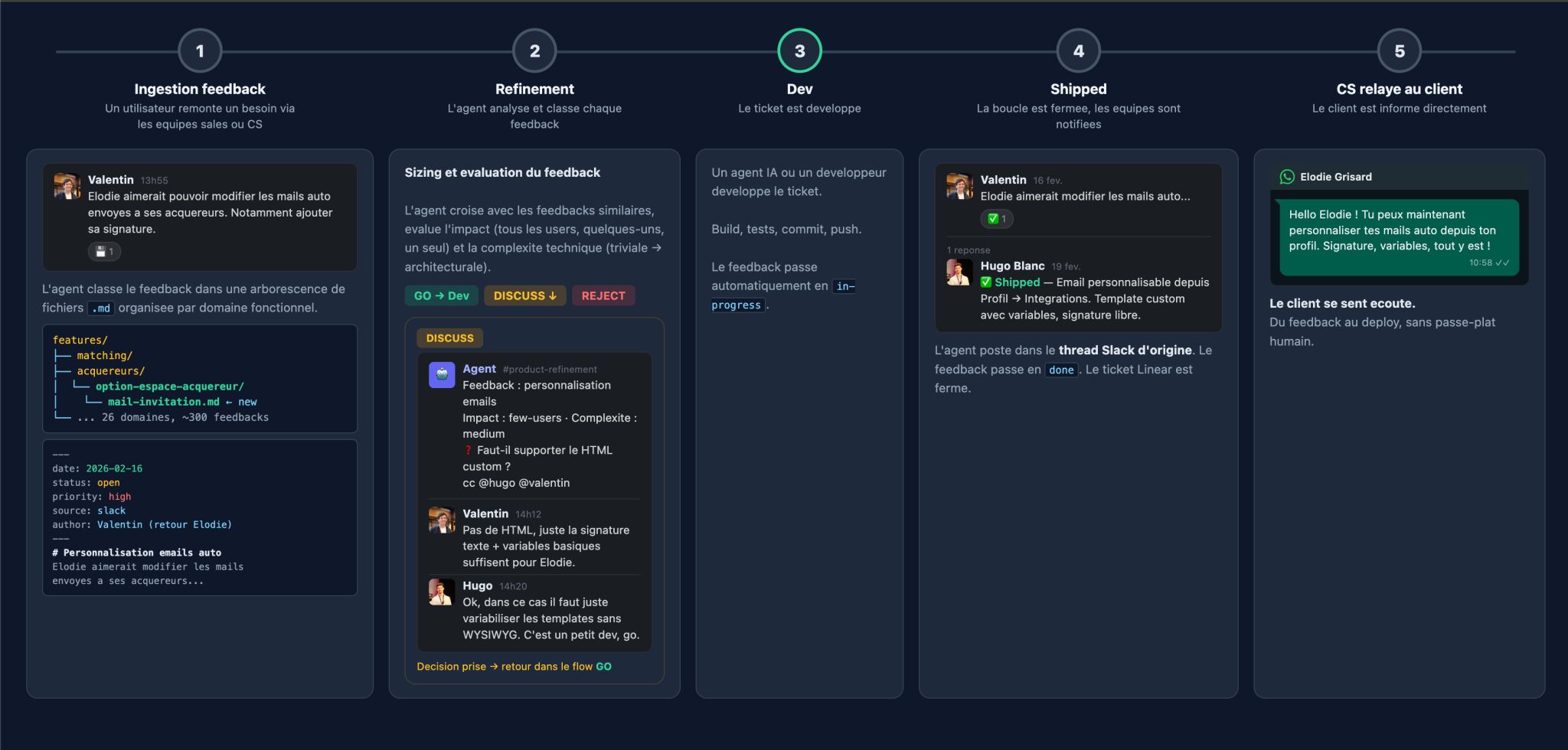
ProductBoard, $800/month. AI agents, a few cents. Same result.
On Superproper, +300 structured feedbacks in a few weeks. Feature requests, field feedback from sales, bugs.
Without a system to sort, prioritize and close the loop, it becomes unmanageable.
Rereading Andrej Karpathy’s viral tweet about the “LLM Wiki”, I realized we’ve been applying the same concept for 4 months.
The idea: an LLM that doesn’t just answer questions, but builds and maintains a persistent knowledge base. It ingests, structures, cross-references.
The bookkeeping, the boring thing everyone abandons after 3 weeks, costs zero effort with an LLM.
Same for us. Except it’s not a wiki. It’s our product feedback base.
Concretely?
A message lands in Slack. The CS team discusses (or not) the ticket in the thread. An agent ingests the whole thing and files the feedback in a tree of markdown files.
The branches of the tree (folders) = the functional domains of the product. The leaves (.md files) = the individual feedbacks.
It cross-references with similar feedbacks already there. Automatic reaction on the Slack message to mark “feedback recorded”.
Another agent does the refinement. Impact x complexity. GO, DISCUSS or REJECT.
If discussion is needed, it posts in a dedicated channel with the technical context and tags the right people.
And the best part: when the dev is done, the agent posts directly in the original Slack thread. “It’s shipped.”
The CS person sees it. Relays it to the customer. The customer feels heard.
That, most feedback tools don’t do. This closed loop, from the field message all the way to “it’s in prod”, without a human playing middleman.
All connected via MCP. Slack and Chatwoot today. Any source tomorrow.
A side observation: companies with a writing culture are going to be massively advantaged. Every Slack thread, every structured discussion, is context the agents use directly.
Text is worth gold. Teams that write well feed agents that understand better, sort better, prioritize better.
Maybe that’s the real “SaaS crisis” in 2026. Not the end of tools. But a team’s ability to clone the useful part of a tool, tailored exactly to its use case. Fast. For almost nothing.
Disclaimer: no, we didn’t replace ProductBoard. We cloned the part we needed, at our scale, for our use case. If you’re 50 PMs with 10k feedbacks/month, that’s a different topic (or maybe not). But if you’re a small product team hesitating to buy an expensive, full-featured tool to use 20% of the features, it’s worth asking the question.